
Evidence
Loose photos
Pictures with no reliable time or place, sent through a chat and impossible to tie to a job.
PILLAR V
Evidence rules decide what each job must prove, safety checklists hold the job until it's safe to start, and a tamper-evident log keeps every critical action.
The problem
In a dispute, having a photo isn't enough. It has to show where and when it was taken, and nobody can have changed it since.
Evidence
Pictures with no reliable time or place, sent through a chat and impossible to tie to a job.
Safety
Paper forms filled in at the end of the day, if at all, when the risk has already been taken.
Records
Spreadsheets and databases that can be changed without a trace can't settle an argument.
How it works
Standards are set once, enforced on site and kept where nobody can alter them.
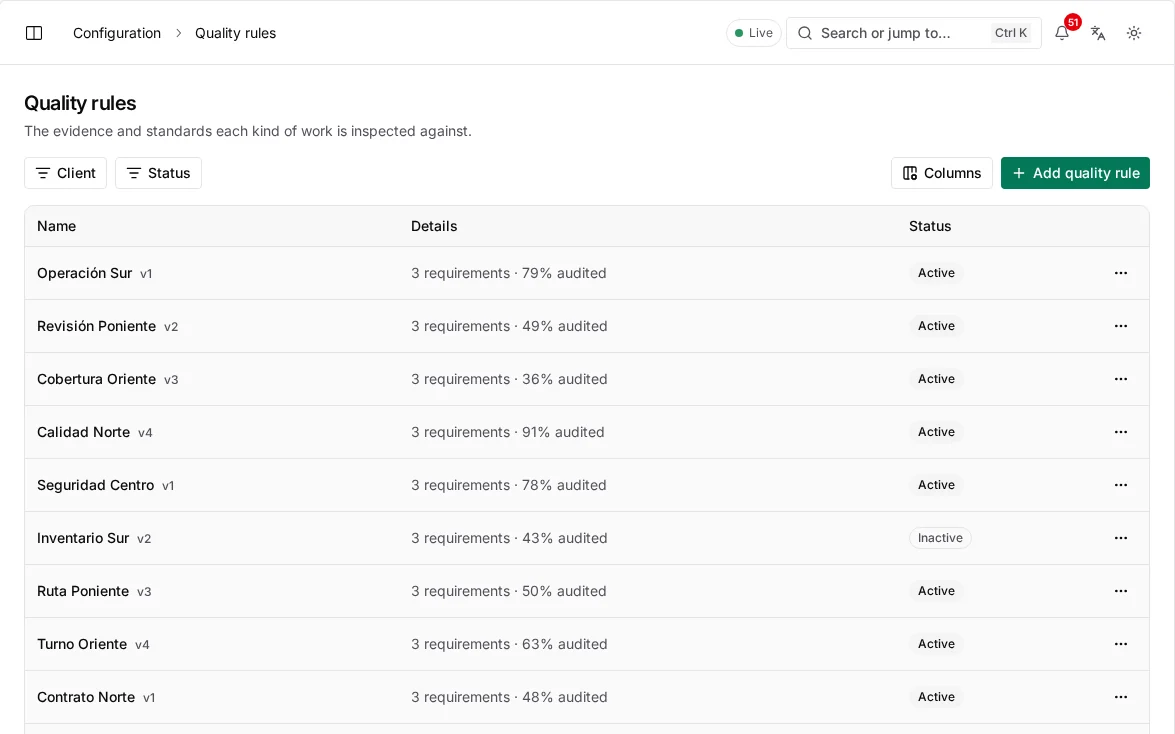
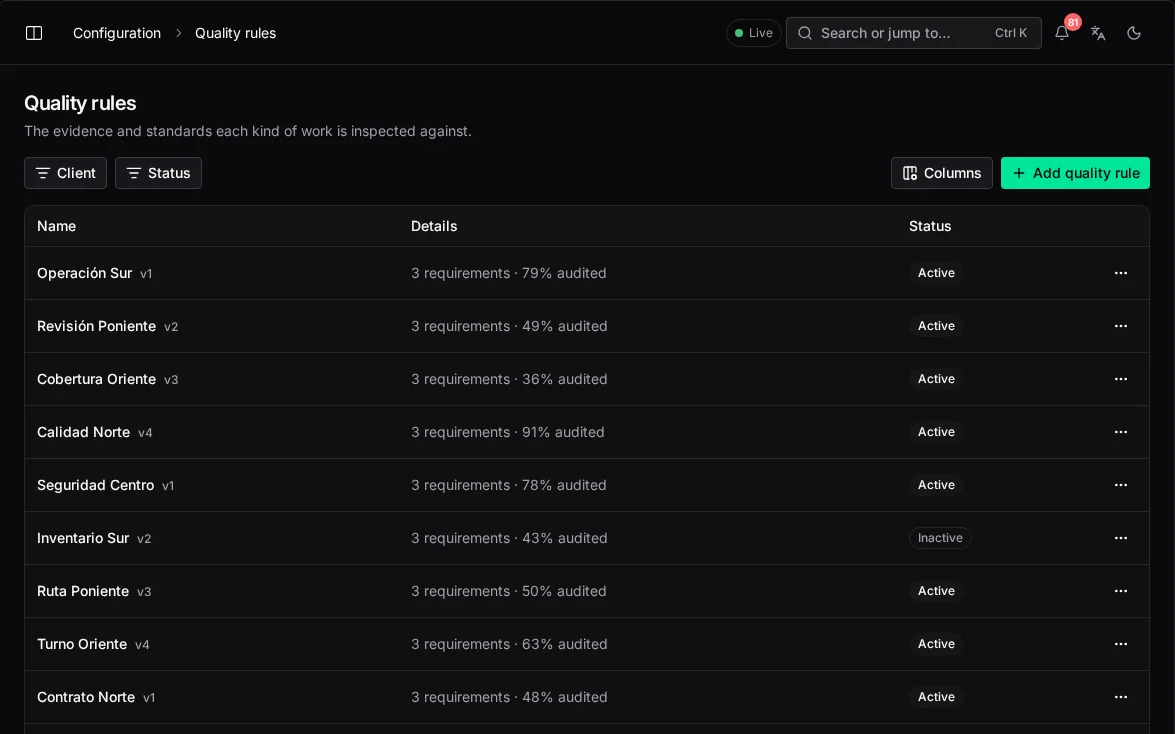
Per client and job type: which photos or videos, how many, and what share of finished work is inspected. A client rule can add to your standard, never weaken it.
rules combine · the stricter requirement wins
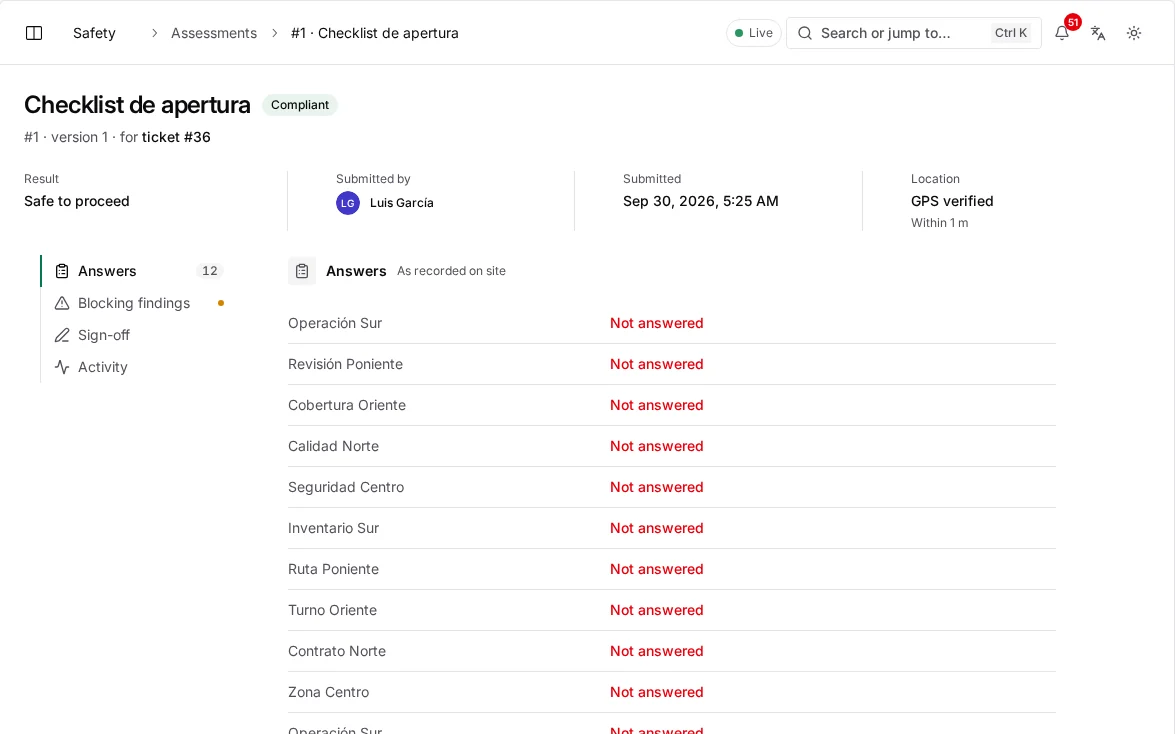
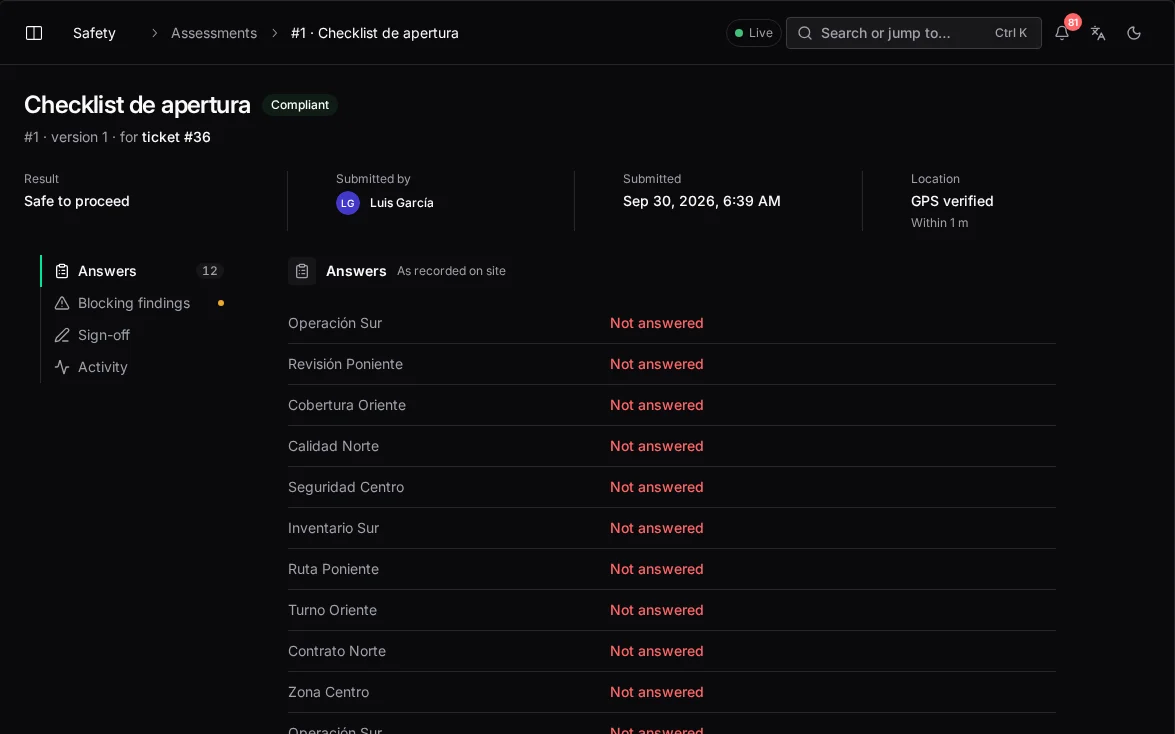
Mandatory safety checklists (JSA) hold the job at arrival. A blocking question answered unsafely stops the work. Hazard reports and the SOS button are always one tap away.
start work only when every mandatory checklist passes
Each capture is tied to its requirement, with GPS position, accuracy and time, stored encrypted and uploaded without blocking the job.
requirement · GPS · accuracy · time
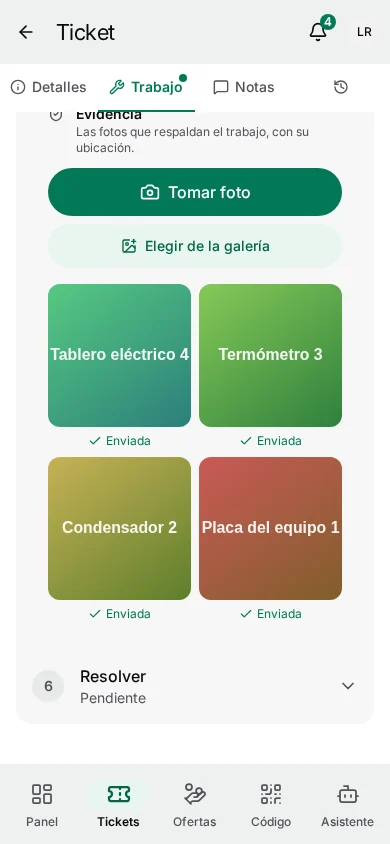
A job can't close while a mandatory requirement is unmet, and the technician can see exactly what's missing.
no evidence, no closure
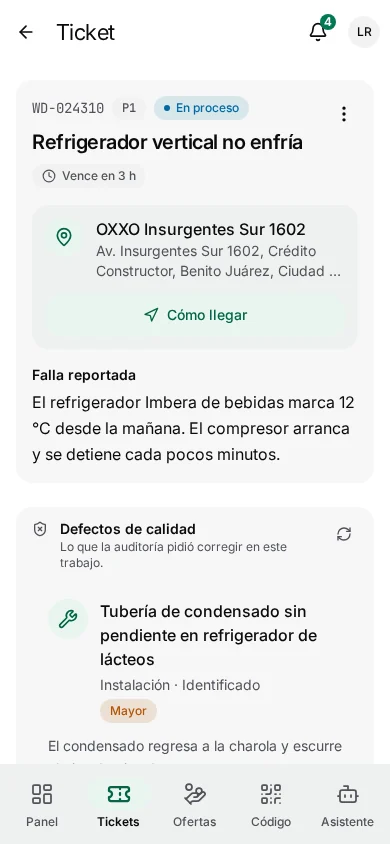
A share of finished work is sampled for inspection. Defects are routed to an owner until fixed, and the fix is verified by someone else.
whoever fixes ≠ whoever verifies
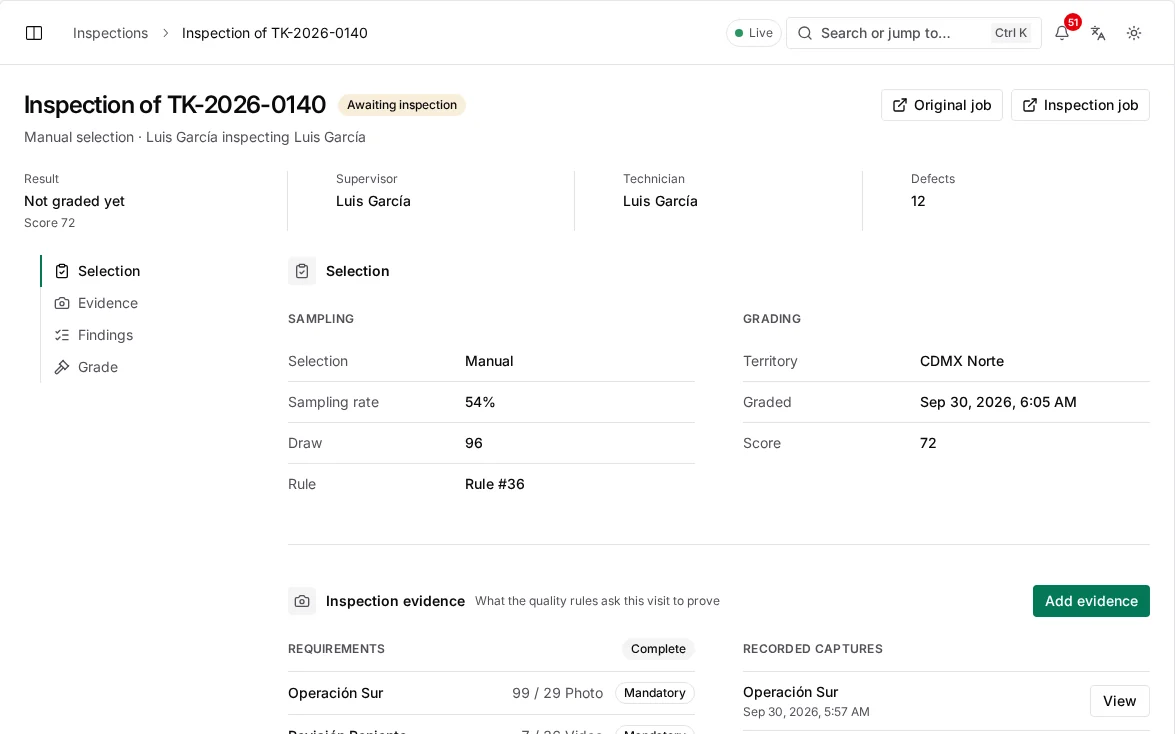
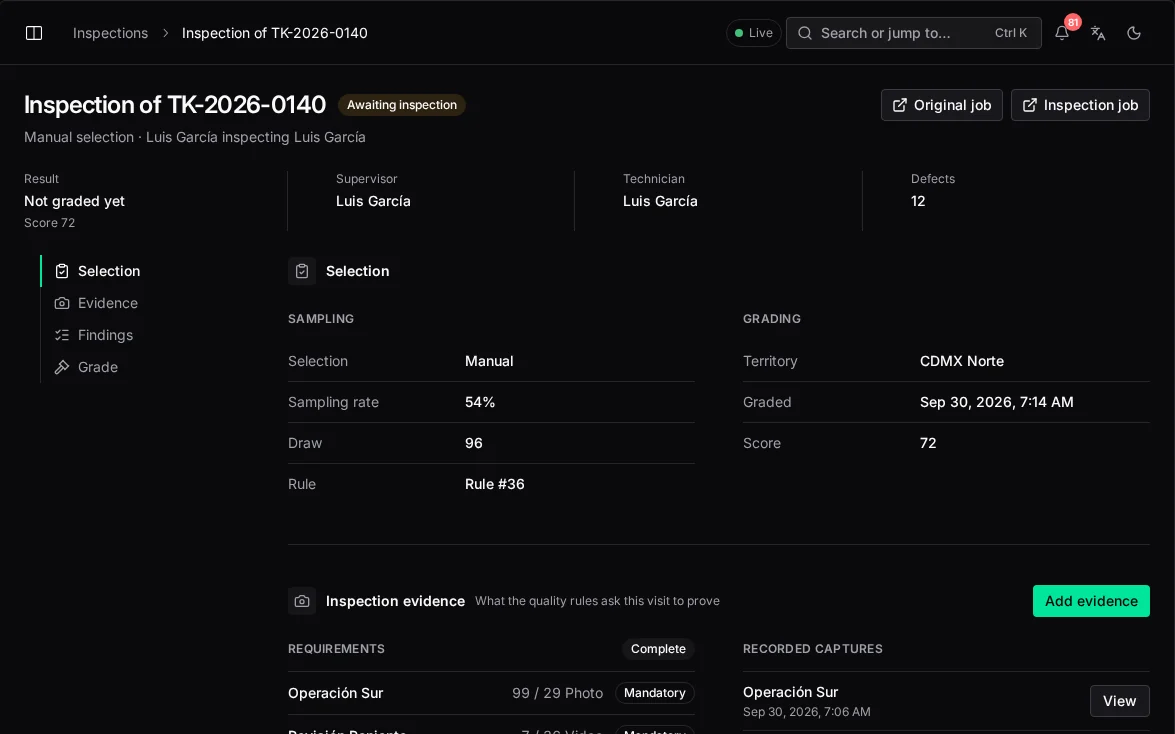
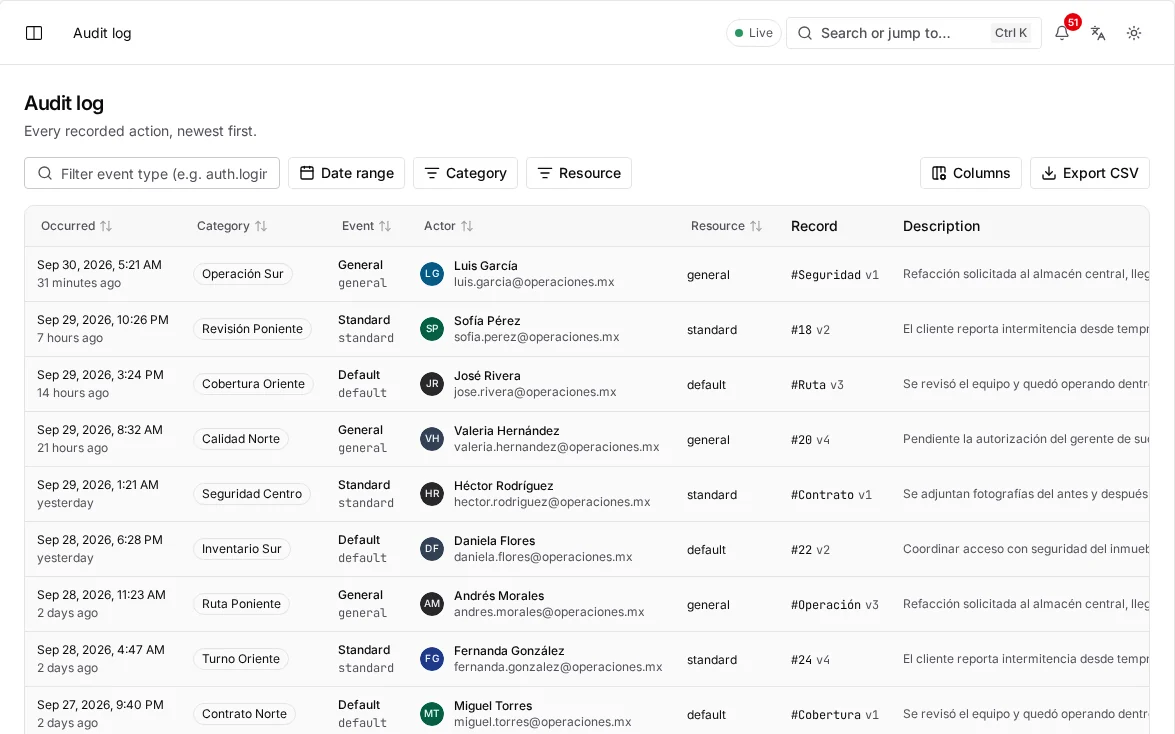
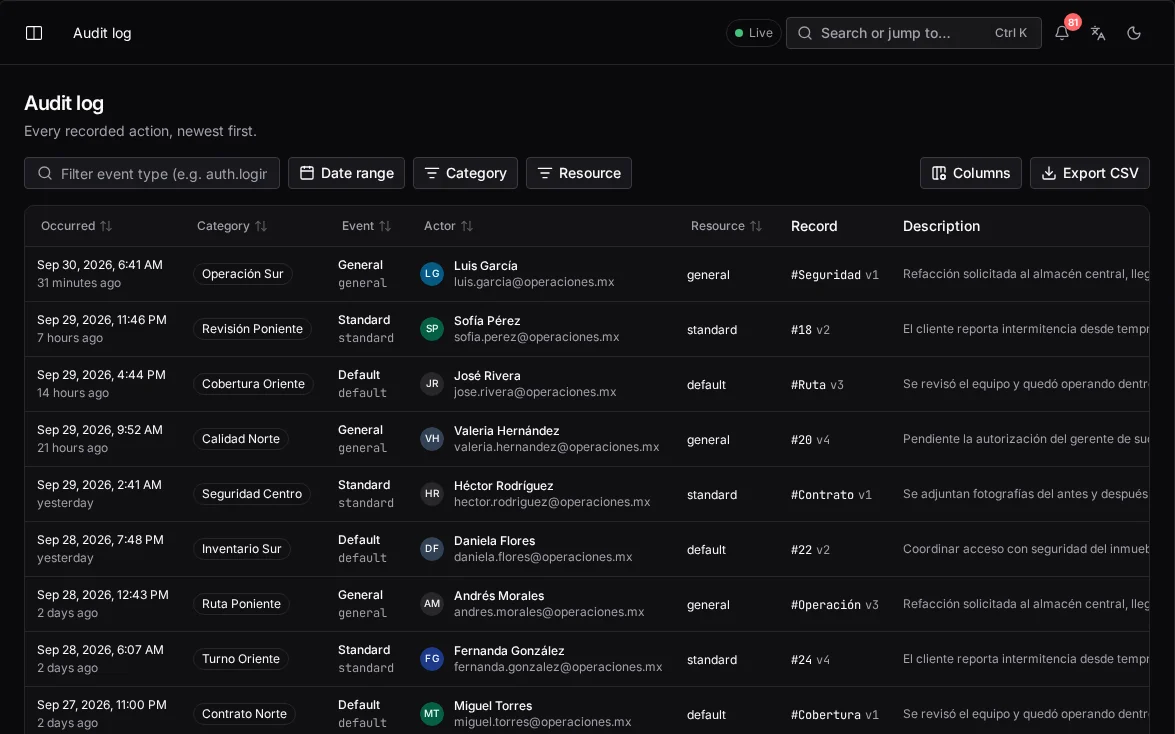
Every workflow event, change, sign-in and sensitive read is written to a hash-chained log, verified every night and kept for seven years.
hash chain · nightly verification · 7-year retention
Per client and job type: which photos or videos, how many, and what share of finished work is inspected. A client rule can add to your standard, never weaken it.
rules combine · the stricter requirement wins
In numbers
Once a job can't close with a photo missing, complete evidence stops depending on who did the work.
Jobs closed with every required photo
The closing rule was switched on in week 3.
| Complete evidence | |
|---|---|
| W1 | 71% |
| W2 | 74% |
| W3 | 88% |
| W4 | 96% |
| W5 | 99% |
| W6 | 100% |
| W7 | 100% |
| W8 | 100% |
Rules that always hold
Tamper evidence
Each log entry's hash covers the one before it. Changing, reordering or removing a row breaks the chain.
Corrections
Attendance, safety checklists and other critical records are corrected through workflows that keep both versions visible.
Privacy
Passwords, tokens, national IDs and bank accounts are masked before anything is stored.
Access
Staff, contractors and clients each see only what they should. A client never sees another client's records.
Sign-in
Authenticator apps with recovery codes, and sessions that can be revoked device by device.
Independence
Compliance writes the safety checklists. Dispatch, who is under pressure to get the van moving, can't change them.
Configuration
Who uses it
Compliance manager
Holds a tamper-evident record of everything and gets anything unusual flagged for review.
Client regional manager
Sees quality audits and evidence from the field without waiting for a month-end report.
Executive
Answers any client or auditor with the full record of the visit, ready.
A 30-minute briefing with your dispatch, payroll and asset flows on screen.
Keep exploring
Intelligence
What each model answers, where it appears, and what it will never do on its own.
The visibility gap
What running on WhatsApp and spreadsheets really costs, and what changes with one record.
Security
Access by role and territory, sign-in, encryption, the audit log and devices in the field.
Changelog
New capabilities and improvements across the console, field app and platform.